
Disrupting Mortality
Can technology overcome humanity's oldest constraint?

“Forever young, I want to be forever young” - Alphaville (1984)
The quest for immortality is as old as time. In the Garden of Eden, God promised Adam and Eve eternal life on one condition: do not eat from the Tree of Knowledge. But temptation won. A serpent deceived Eve, Adam followed suit, and the forbidden fruit was eaten. This “Fall of Man” sealed their fate. An angry God banished them, declaring: “Dust you are, and to dust you shall return.”
Goodbye immortality, hello mortality.
This obsession echoes across almost every ancient culture. Take the Epic of Gilgamesh, written around 2100 BC in ancient Mesopotamia. Gilgamesh—a king two-thirds god and one-third human—desperately sought eternal life. He tracked down Utnapishtim, a survivor of the great flood, and successfully retrieved the plant of youth. But while the king napped, a snake stole it away, leaving Gilgamesh to return home and face his mortal end.
For millennia, humans simply couldn’t escape this fate. In fact, if I were to ask you what the global life expectancy was as recently as the year 1900, what would you say? 50? 60?
The truth is, it was just 32 years old.
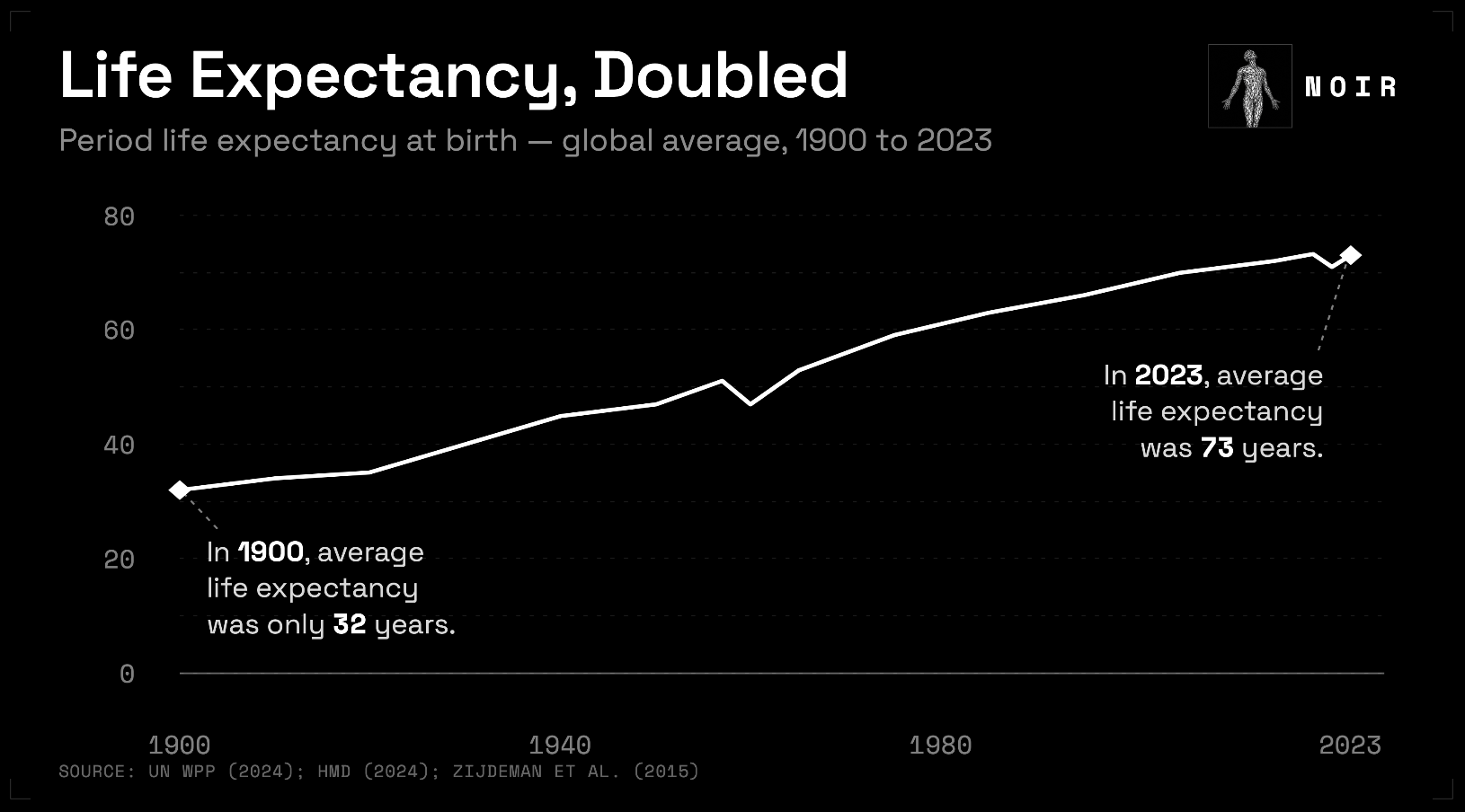
Since then, our life expectancy has more than doubled. This remarkable increase is due to improved living standards, like better nutrition and sanitation, and advances in healthcare, such as antibiotics and vaccines.
Strictly speaking, evolution doesn’t strive for perfection; it thrives on what’s “good enough” to pass on our genes. Historically, living to 30 was more than good enough. Yet today, we have completely shattered those biological limits. And because we have conquered the basic threats to survival, the ancient dream of defeating death has suddenly become a hot topic once again.
But there is a catch. This modern pursuit of extreme longevity is no longer a spiritual quest—it has become the ultimate playground for the ultra-wealthy and the hyper-powerful.
We saw a fascinating example of this last year. During a military parade in Beijing, a rare hot-mic moment caught Chinese President Xi Jinping and Russian President Vladimir Putin in a private chat. Flanked by interpreters, Putin mused about how biotechnology and organ transplants might allow people to grow younger and “even achieve immortality.” Xi agreed, laughing that at age 70, a person is “still a child,” and predicted humans will soon routinely live to 150.

It seems that thousands of years after Adam, Eve, and Gilgamesh, the absolute rulers of the modern world are still chasing the exact same thing: a way to outsmart the snake, rewrite the rules of evolution, and hold onto their power forever.
But it isn’t just world leaders chasing this dream; it is primarily the tech moguls and venture capitalists who are placing astronomical bets on it today. In recent years, a massive network of billionaires has emerged, flooding the longevity space with capital. This is no longer a niche hobby, but a serious multi-billion-dollar industry where the average fundraising round has grown by more than 20% over the past decade to nearly $43 million per deal, according to WSJ estimates. The sums these tech giants are investing to rewind the biological clock are staggering. Altos Labs raised $3 billion—the most of any identified longevity company—to develop technology aimed at rejuvenating cells.
Meanwhile, Brian Armstrong’s fundraising for his cell-reprogramming company, NewLimit, included a $130 million round backed by the funds of fellow billionaires Vinod Khosla and Peter Thiel. Additionally, hundreds of millions of dollars are pouring into other pioneers; the artificial-intelligence drug discovery company Insilico Medicine raised more than $500 million to treat multiple age-related diseases , and BioAge Labs raised $559 million to develop drugs targeting the diseases of aging.
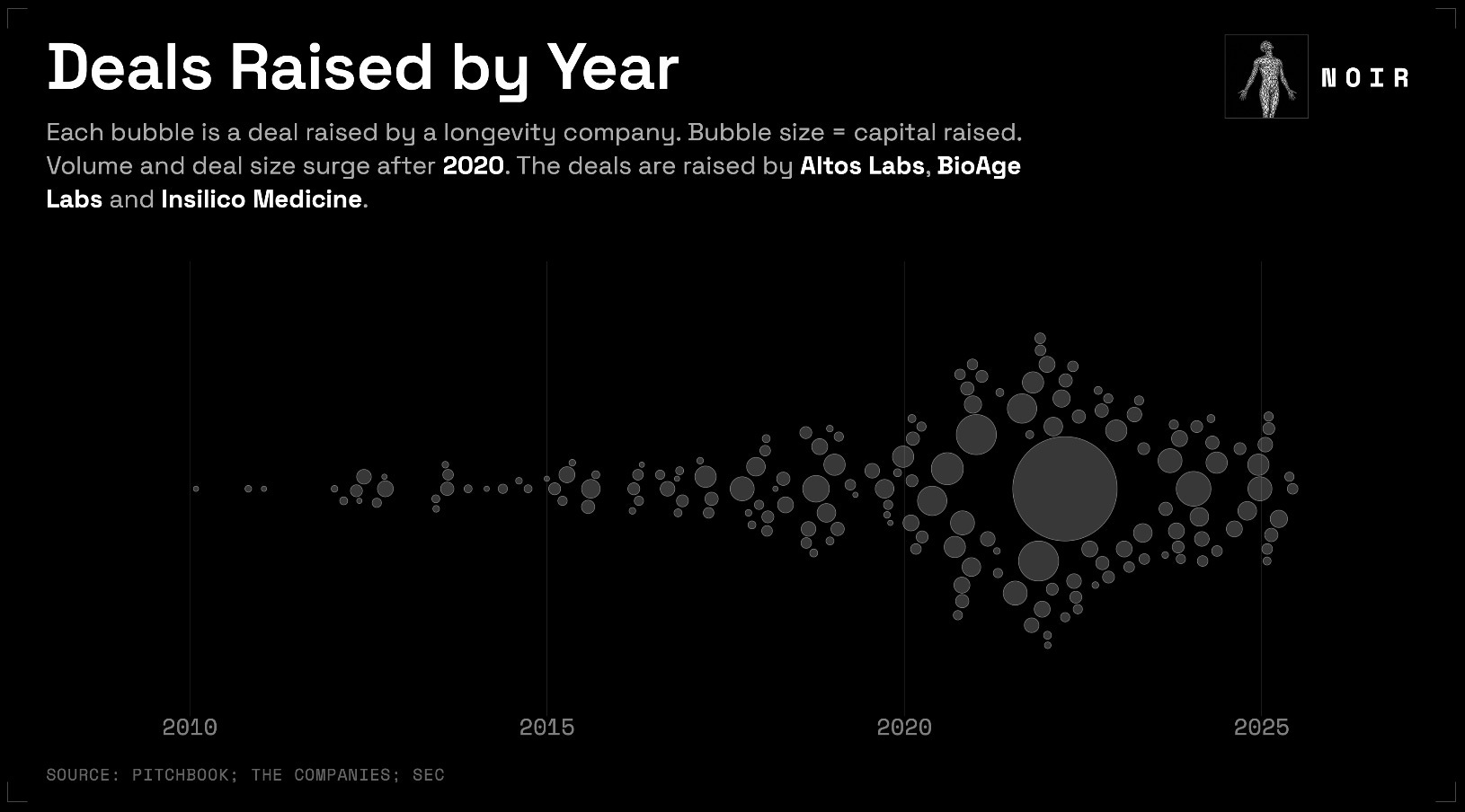
While the average person accepts that we are biologically programmed to decline, these tech moguls refuse to see death as an inevitability.
A lot of people already make it past the age of 100 and they are healthy, so there is no reason that shouldn't be achievable for all of us. For this modern elite, mortality is no longer a natural law, but simply a technical error in our code waiting to be solved. They are following the money and the science to rewrite the rules of evolution, chasing the ultimate form of inequality: a world where biological age can be bought, and where the wealthiest do not just own the most capital, but also the most time.
But to truly achieve this, these billionaires aren’t just fighting evolution—they are fighting a mathematical law. In biogerontology, there is a concept known as Gompertz’ Law of Mortality. Formulated in the 19th century, this law shows that once a human hits the age of 30, their probability of dying doubles roughly every eight years. It is a brutal, exponential curve built into the very fabric of our biology.
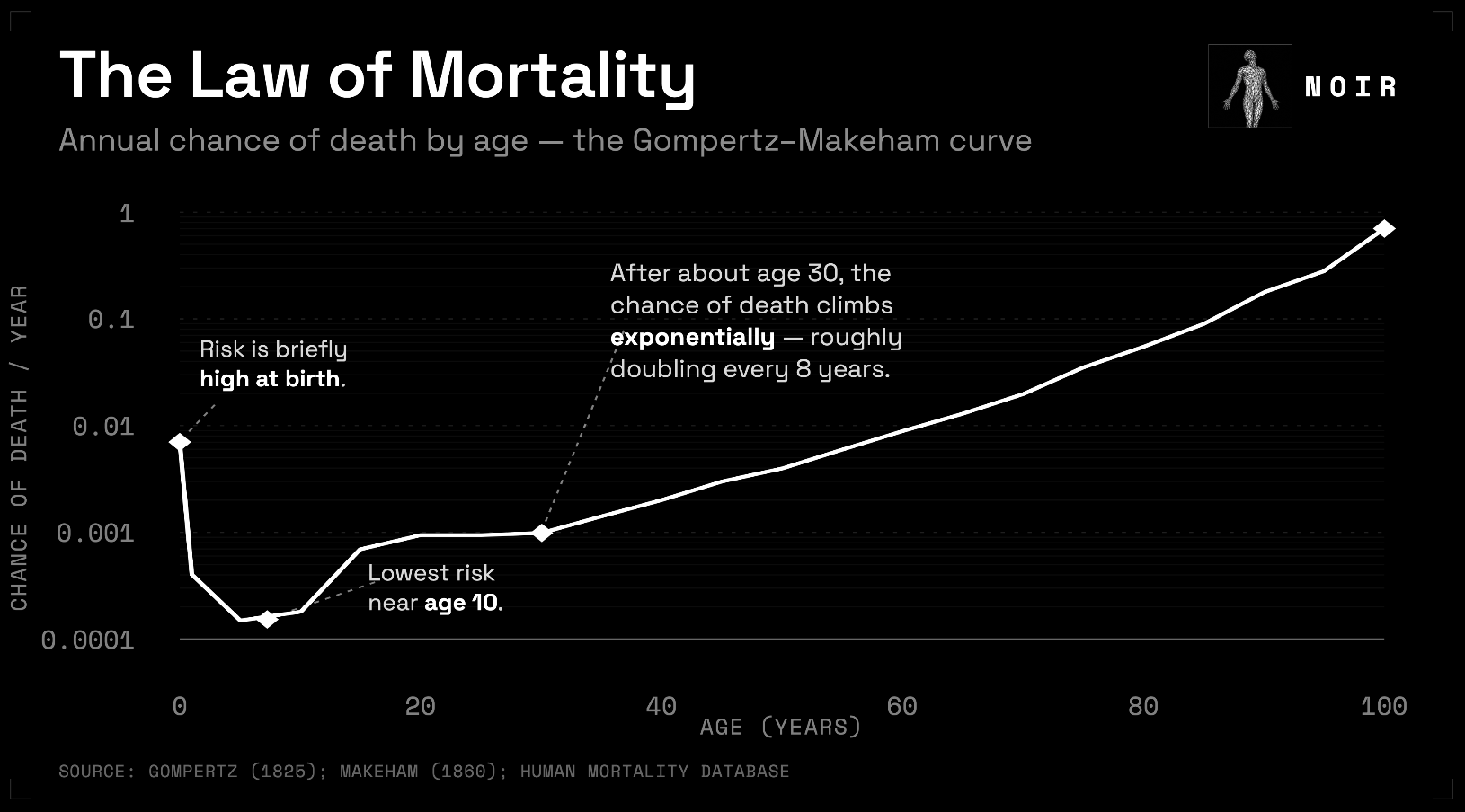
For thousands of years, this mathematical wall has remained undefeated. Rulers have conquered empires, and tech moguls have disrupted entire industries, but none have ever disrupted Gompertz’ law.
The ultimate question is no longer how much money they are willing to pour into the science, but whether even the deepest pockets in the world can meaningfully push back against one of nature's most fundamental constraints.
♡ Like this piece if you don’t think you will be reading this in 2167…
Really enjoyed this instalment - thank you for sharing.
Quite ironic to see modern rulers casually discussing 150-year lifespans, sounding exactly like the kings and pharaohs they replaced.
The fact that "Biological age can be bought." really describes the stakes here. The trend toward longer lives has been running for a century as you've demonstrated.
I feel that the new question is whether the rich start living dramatically longer than everyone else, and what that does to a society already struggling with concentrated wealth.
Do you see the longevity space producing a genuinely accessible breakthrough that is kept hush hush, or does the funding structure point toward something that stays gated?